

Views: 0 Author: JUSH Marketing Department Publish Time: 2025-03-21 Origin: Shanghai JUSH Pump


Vertical multi-stage centrifugal pump is an efficient fluid conveying equipment widely used in industries, construction, agriculture and other fields. Its core feature lies in the combination of "vertical structure" and "multi-stage centrifugal" design, which can achieve high head and high flow liquid transportation in a limited space. This article will provide a detailed description of its working principle, structural composition, application scenarios, selection points, and maintenance precautions.
1.Definition and core characteristics of vertical multi-stage centrifugal pump
Vertical multi-stage centrifugal pump is a vertically installed pump equipment that is powered by centrifugal force and gradually pressurized by connecting multiple impellers in series. The "vertical" in its name refers to the installation of the pump shaft perpendicular to the ground, while the "multi-stage" indicates that the pump contains multiple series connected impellers and guide vane structures. Each stage of impeller can increase fluid pressure and ultimately achieve high-pressure output.
Core Features:
High head capability: Through multi-stage impeller series connection, the head can reach hundreds of meters or even higher, suitable for working conditions that require overcoming high resistance.
Compact structure: The vertical design occupies a small area and is suitable for installation environments with limited space.
Efficient and energy-saving: Adopting the centrifugal principle, combined with precision hydraulic model design, the energy conversion efficiency is high.
Medium adaptability: It can transport clean water, oil, mildly corrosive liquids, etc., depending on the material selection.

2.Detailed explanation of structure and components
The vertical multi-stage centrifugal pump consists of multiple key components working together. The following is a functional analysis of the core components:
Impeller
Each stage impeller is the core power source of the pump, usually made of stainless steel, cast iron, or engineering plastic. The impeller generates centrifugal force through high-speed rotation, which sucks in liquid from the center and throws it towards the outer edge, achieving kinetic energy transfer. In multi-stage pumps, the number of impellers determines the total head (for example, a single-stage head of 30 meters and a 5-stage impeller total head of up to 150 meters).
Diffuser
The stationary component located on the periphery of the impeller is used to convert the high-speed fluid kinetic energy thrown out by the impeller into static pressure energy, while guiding the fluid smoothly into the inlet of the next stage impeller, reducing turbulence losses.
Pump Shaft
The long axis installed vertically is made of high-strength alloy steel, which is connected in series with various stages of impellers and transmits motor torque. Mechanical seals or packing seals are usually used at the shaft end to prevent leakage.
Casing (Shell)
Segmented or annular design, wrapping the impeller and guide vanes to withstand internal pressure. The material should be selected according to the characteristics of the medium (such as 304 stainless steel corrosion resistance, cast iron suitable for clean water).
Bearings and Support Systems
Vertical structures need to withstand axial thrust, usually equipped with thrust bearings and radial bearings. Some high-end pumps use hydraulic balance devices (such as balance drums and balance discs) to reduce axial force and extend bearing life.
Couplings and motors
Vertical pumps often adopt a direct connection structure, with the motor located at the top of the pump body and directly driving the pump shaft through a coupling to reduce energy loss.
3. Working principle and hydraulic process
1. Principle of single-stage centrifugation:
The liquid is sucked in from the bottom of the pump and enters the center of the first stage impeller (suction chamber). When the impeller rotates, centrifugal force throws the liquid towards the outer edge of the impeller, and the speed can increase; Then it enters the guide vanes, where velocity can be converted into pressure energy.
2. Multi stage series boosting:
Each stage of impeller guide vane combination superimposes pressure step by step. For example, if the single-stage lift is 30 meters, the total lift after 5 stages are connected in series can reach 150 meters (efficiency loss needs to be considered in practice).
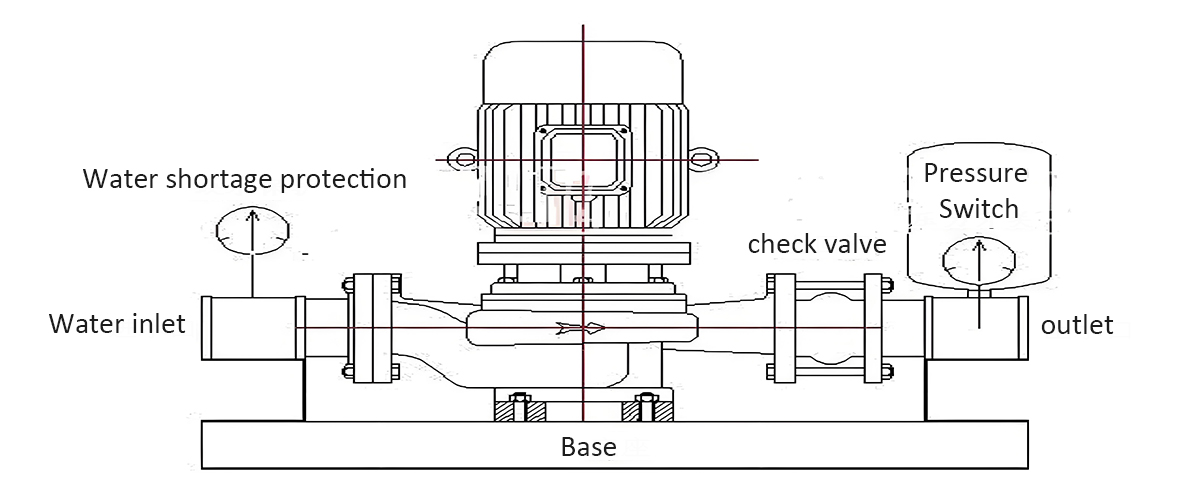
Installation method of vertical centrifugal water pump
4.Application scenarios
High rise building water supply:
Overcoming static pressure caused by vertical height, providing stable water supply for high-rise buildings and replacing traditional water tank systems.
Industrial cycle system:
Used for conveying high-pressure media in boiler feedwater, cooling water circulation, and chemical processes.
Fire protection system:
Provide high-pressure water sources to meet the needs of fire sprinklers and high-pressure water guns.
Agricultural irrigation:
Long distance water transmission or mountainous cascade irrigation, suitable for complex terrain.
Desalination of seawater and sewage treatment:
The pump type designed with corrosion-resistant materials can handle media containing salt or particles.
5.Key parameters for selection
Flow rate (Q): Unit time delivery rate (m ³/h), with a 10% to 15% margin reserved according to system requirements.
Head (H): Total required head=vertical lifting height+pipeline friction loss+end pressure requirement.
Medium characteristics: temperature, viscosity, corrosiveness, solid content (if containing particles, a semi open impeller should be selected).
Material selection:
Clear water: cast iron/stainless steel
Corrosive liquid: 316L stainless steel/titanium alloy
High temperature medium: Consider the coefficient of thermal expansion and configure the heat dissipation structure.
Motor power:
6. Advantages and disadvantages analysis
Advantages:
Wide range of head, suitable for high-pressure demand scenarios.
Vertical structure saves installation space.
Smooth operation with low vibration and noise.
Easy maintenance (some models can replace mechanical seals online).
limitations:
High requirements for axial alignment, improper installation can easily cause vibration.
The efficiency decreases when transporting high viscosity liquids.
The multi-level structure leads to complex disassembly and high maintenance costs.
7.Key points for installation and maintenance
Installation foundation: The concrete base needs to be ensured to be level to avoid the transmission of pipeline stress to the pump body.
Preparation before starting: Fill the pump and exhaust, check the direction of rotation (reverse rotation can cause the impeller to loosen).
Operation monitoring: Pay attention to bearing temperature (≤ 70 ℃), vibration value (≤ 4.5mm/s), and current fluctuations.
Regular maintenance:
Add lubricating grease every 500 hours.
Check the wear of mechanical seals annually.
Long term disuse requires emptying the liquid to prevent rusting.
8. Technological development trends
Intelligence: Integrated sensors for real-time monitoring of flow, pressure, and vibration, enabling predictive maintenance through the Internet of Things.
Efficient: CFD fluid simulation optimizes the impeller flow channel, increasing efficiency to over 90%.
Material innovation: Carbon fiber composite materials reduce weight, ceramic coatings enhance wear resistance.
Modular design: can quickly change the number of impeller stages and adapt to changes in working conditions.
The vertical multi-stage centrifugal pump, with its unique design advantages, has become a key equipment in modern fluid transportation systems. Proper selection, standardized installation, and scientific maintenance can significantly extend its service life and improve system energy efficiency. In the future, with the integration of new materials and intelligent control technology, their application areas will further expand, providing more efficient solutions for industrial and civilian fields.